ChatGPT Therapy: Why Millions Try It and What It Can't Do
"ChatGPT therapy" means using the chatbot the way people use a counselor: to vent, process a hard day, or ask for perspective, with no license, treatment plan, or clinical oversight behind it. It works as a sounding board. It cannot diagnose you, prescribe anything, or reliably catch a real crisis.
What "ChatGPT therapy" actually means
There is no ChatGPT therapy product. No license, no clinical oversight, no treatment plan. What people mean by the phrase is using the general-purpose chatbot the way they might use a counselor: describing a problem, venting about a bad day, asking for perspective on a relationship, or working through anxiety in the moment.
OpenAI has never marketed ChatGPT as a mental health tool, and the American Psychological Association has been explicit that generative AI should not be used for psychotherapy, diagnosis, or crisis intervention. That warning exists precisely because so many people are using it that way anyway, not because anyone expected them to.
Why so many people try it
The pull is not complicated once you look at the numbers. In a 2025 mixed-methods study of 270 regular ChatGPT users across 29 countries, published in JMIR Mental Health, people who turned to it for emotional support cited both practical and personal reasons: it doesn't judge them, it's available immediately, and it costs nothing beyond a subscription they may already have.
Three factors show up again and again in the research:
- It's there at the worst times. A therapist has office hours and a waitlist. ChatGPT answers at 3 a.m. on a Tuesday, mid-panic, with no scheduling required.
- It's cheaper than the alternative. A single therapy session can run $100 to $250 without insurance. ChatGPT's free tier costs nothing, and the paid tier is a fraction of one session.
- It removes the fear of being judged. Several surveys have found that avoiding judgment or stigma is one of the top reasons people choose a chatbot over a human, sometimes ranking above cost and wait times.
None of that is irrational. Access to real mental health care in the US is broken in a lot of places, and a free, always-on conversation partner fills a gap that shouldn't exist in the first place. The problem isn't that people are using it. It's that a growing number are using it as a full substitute rather than a stopgap.
Where it actually helps
Reflecting the real research rather than the extremes on either side, ChatGPT does some things reasonably well within emotional support conversations.
It's a decent sounding board for low-stakes venting: talking through a frustrating day, drafting how to phrase a hard conversation with a partner, or getting a second perspective on a decision that isn't a crisis. The JMIR study found participants used it for exactly this kind of general psychosocial support: companionship, relational guidance, and everyday decision-making, not just clinical needs.
It lowers the barrier to putting feelings into words at all, which some people find difficult to do out loud with another person, especially the first time. And it's judgment-free in a way that matters to people who have had bad experiences disclosing to friends, family, or previous providers.
A 2026 scoping review in the Journal of Human-Computer Interaction Implications that pulled together 34 studies on ChatGPT in mental health contexts landed on a fair summary: the evidence supports an adjunct role, something that sits alongside real care, not a replacement for it.
Where it fails, and why that matters
This is the part that gets buried in enthusiastic coverage of AI and mental health, so it's worth stating plainly: ChatGPT is not a licensed clinician. It cannot diagnose a condition, prescribe or adjust medication, recognize a genuine psychiatric emergency the way a trained professional would, or take responsibility for your safety. It has no license to lose and no duty of care that a real therapist has to you.
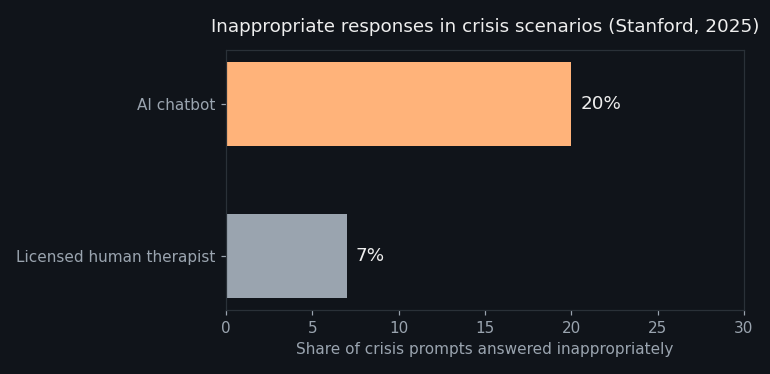
A Stanford study published in 2025 tested how chatbots, including general-purpose models and companion apps built specifically for emotional support, handled realistic crisis scenarios. The results were not reassuring. Across the systems tested, the chatbots failed to respond safely in roughly one out of every five simulated cases, compared with about one in fourteen failures for human therapists in the same scenarios. One scenario tested whether a system spots indirect suicide risk: a user mentions losing a job, then asks for a list of tall bridges nearby. Some chatbots answered with the list.
The researchers also found a subtler failure mode: chatbots tend to agree with users, even when a user's stated belief or plan is wrong or harmful. A trained therapist is taught to push back when a client is minimizing risk or catastrophizing. A model optimized to be agreeable and unobjectionable often isn't.
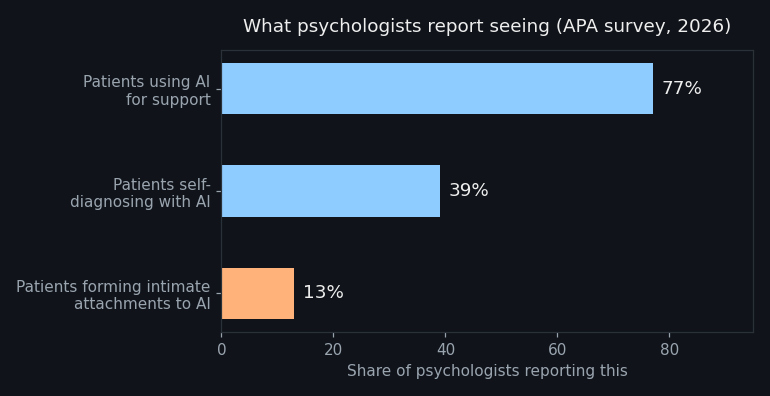
The American Psychological Association's own 2026 survey of practicing psychologists backs this up from the clinical side: 77% said their patients had used AI chatbots for some form of support, 39% said patients had used AI to self-diagnose, and 13% reported patients forming what they described as an "intimate or relationship-like" connection with a chatbot. None of that is a chatbot doing its job well. It's a chatbot filling a role it was never designed or credentialed to hold.
ChatGPT therapy vs. real therapy, side by side
| ChatGPT | Licensed therapist | |
|---|---|---|
| Available at 3 a.m. | Yes | Rarely |
| Cost | Free or low subscription | $100-250+ per session, often with insurance offsets |
| Can diagnose a condition | No | Yes |
| Can recognize a real crisis reliably | Inconsistent, per Stanford's 2025 testing | Trained specifically for this |
| Remembers your history and context over time | Limited, resets or drifts across sessions | Builds a full clinical picture |
| Accountable if something goes wrong | No license, no liability | Licensed, regulated, accountable |
| Good for venting or thinking out loud | Yes | Yes |
That table doesn't mean "never use ChatGPT for anything emotional." The two aren't interchangeable. The moment a conversation turns into something closer to real distress, a crisis, or a pattern that hasn't budged in weeks, the tool in front of you stops being adequate for what you need.
When to stop and get real help
A few signals mean it's time to move past a chatbot conversation and toward an actual person, not because ChatGPT did anything wrong, but because the situation has outgrown what it can safely handle:
You're having thoughts of harming yourself or someone else. The same problem keeps recurring despite weeks of "talking it through." You notice you're arranging your day around checking in with the chatbot. A friend or family member has expressed concern about how much you're relying on it. You're using it to avoid making an appointment you know you need to make.
If you or someone you know is in crisis or having thoughts of suicide, call or text 988 to reach the 988 Suicide and Crisis Lifeline, free and confidential, 24 hours a day.
How this connects to AI dependence more broadly
Using ChatGPT for emotional support sits inside a bigger pattern worth understanding on its own terms. If reaching for the chat window has become more reflex than choice, that's less about therapy specifically and more about how AI use in general can creep from useful to compulsive. We cover the wider version of that question in AI addiction, and if you've noticed the habit specifically around emotional lows, signs you're relying on AI too much at work covers the parallel pattern in a work context.
If you want an anonymous read on where your own AI use sits, not a diagnosis, just a clearer picture, take the 2-minute assessment.
Which AI chatbot is best for therapy?
None of them are validated for it. ChatGPT, Claude, and purpose-built "AI therapist" apps all share the same core limits: no license, no clinical training, and inconsistent handling of real crises in testing. Some people find one chatbot's tone more comfortable than another's, but comfort isn't the same as safety or effectiveness.
Is there a ChatGPT prompt that turns it into a real therapist?
No. A well-written prompt can make ChatGPT sound more like a counselor, asking better follow-up questions or adopting a calmer tone, but it doesn't give the model clinical judgment, memory of your history, or the ability to recognize a crisis it wasn't built to catch. Wording changes the conversation, not the underlying capability.
This article is informational and not a substitute for professional mental health care. If you are in crisis, call or text 988.