Will AI Replace Teachers? What the 2026 Evidence Says
No, AI is not going to replace teachers, and the data actually points the other way. The world is short roughly 44 million teachers, not overstaffed with them. What AI is doing is quietly taking over slices of the job, mostly the grading and planning that eat a teacher's evenings, while leaving the part that needs a human standing in the room.
That gap between the headline fear and the ground truth is worth sitting with. The question "will AI replace teachers" almost always imagines a robot at the whiteboard. The real change looks nothing like that. It looks like a teacher spending twenty fewer minutes writing a quiz and twenty more minutes with the kid who's falling behind.
If you teach and you want a personal read on where your own role stands, our free How AI-Proof Is Your Job? assessment scores your actual weekly tasks in about 2 minutes. The reasoning behind it is below.
The shortage is the story, not the surplus
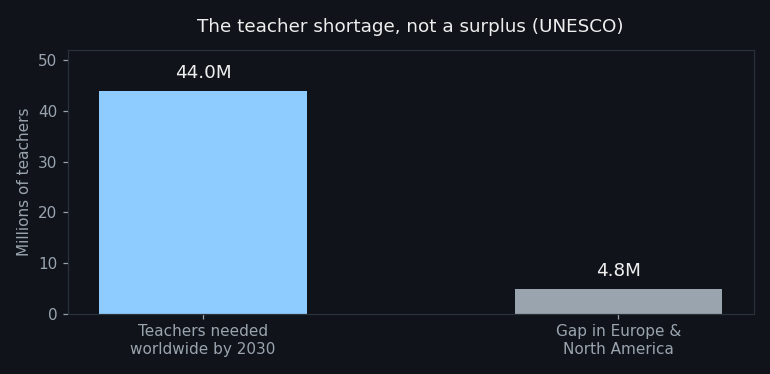
Start with the numbers, because they flip the premise. UNESCO estimates the world needs 44 million more teachers by 2030 to hit universal education targets, with more than half of today's teachers projected to leave the profession by the end of the decade (UNESCO). In Europe and North America alone the gap runs to 4.8 million. The teacher shortage is not a workforce being automated out of existence. It is a workforce that schools cannot fill fast enough.
Put the fear next to the demand and it stops making sense to picture layoffs. You do not replace a job nobody can staff. The more realistic risk, and it is a real one, is that districts treat AI as a reason to hire fewer people or pack more students into a room, betting software can cover the difference. That is a budgeting decision, not a technical inevitability, and it is the thing worth watching.
What the experts actually predict
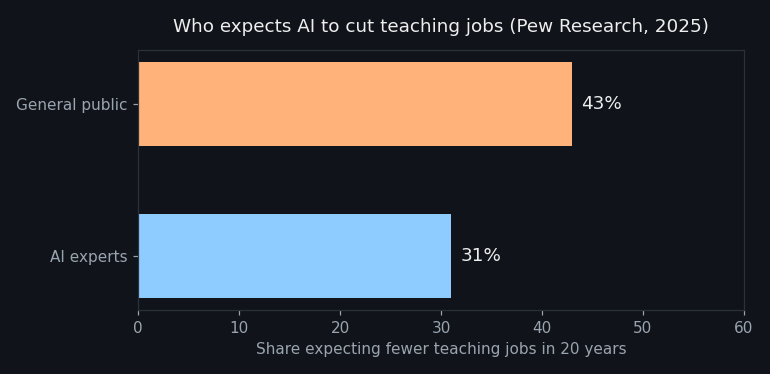
The people closest to the technology are more measured than the public. In Pew Research Center's 2025 survey, 31% of AI experts said they expected AI to lead to fewer teaching jobs over the next 20 years. Among the general public, that figure was 43% (Pew Research Center).
Two things stand out. First, even the experts who worry are a minority. Second, the public is noticeably more anxious than the specialists, which is the usual shape of an automation panic: the fear outruns the forecast. Teaching consistently lands well below jobs like factory work, data entry, and cashiering on expert lists of what AI is likely to shrink.
Where AI is taking over
Here is the honest part. AI is absorbing real tasks, and pretending otherwise helps no one.
The Gallup and Walton Family Foundation survey of 2,232 U.S. public school teachers found that those who use AI weekly save an average of 5.9 hours a week, which adds up to about six weeks of working time over a school year (Gallup). The tasks driving those savings are the predictable ones: drafting lesson plans, generating practice questions, writing first-pass feedback, differentiating a worksheet for three reading levels, sorting through resources.
Notice what all of those have in common. They are preparation and paperwork. They are the tasks a teacher does alone, at a desk, often after hours. None of them is the moment a student finally understands fractions because someone read the confusion on their face and tried a third explanation.
So the accurate sentence is not "AI replaces teachers." It is "AI is taking the desk work off teachers' plates." Whether that is good or bad depends entirely on what schools do with the reclaimed hours.
What AI can and cannot do in a classroom
Put the two columns side by side and the shape of the change is obvious. Everything on the left is work a teacher does alone. Everything on the right happens in front of another human being.
| What AI can already do | What AI cannot do |
|---|---|
| Draft lesson plans and unit outlines | Read confusion on a face and change tack mid-sentence |
| Generate practice questions and quizzes | Decide what a particular child needs on a particular morning |
| Write first-pass feedback on written work | Hold the relationship that makes a struggling student keep trying |
| Differentiate a worksheet across reading levels | Manage a room of thirty adolescents in real time |
| Translate materials for multilingual learners | Carry legal accountability for a child's safety and progress |
| Sort and surface teaching resources | Notice the kid who has gone quiet for three weeks |
The left column is roughly the 5.9 hours a week Gallup found teachers reclaiming. The right column is the job.
What about Bill Gates' prediction?
This is the claim most people are actually asking about. In March 2025, on The Tonight Show, Bill Gates said that within a decade humans "won't be needed for most things", and that "great medical advice, great tutoring" would become free and commonplace.
Read the sentence closely, because the widely shared version drops half of it. Gates predicted free, abundant tutoring. Tutoring is one-to-one content delivery, and it is genuinely the part of education AI is best at. He did not predict the end of classroom management, of safeguarding, of the legal duty of care a school carries for a child, or of the daily judgment calls that make up most of a teacher's actual working day.
It is also worth noting who disagrees. The same Pew survey that found 31% of AI experts expect fewer teaching jobs found 43% of the general public expecting it. On this question the people closest to the technology are markedly less alarmed than everyone else, which is the reverse of the usual pattern.
The tasks AI can't touch
The core of teaching sits in a place current AI cannot reach, and it is not close.
Reading a room is one. Knowing that a normally chatty student went quiet and that it probably is not about the lesson. Managing thirty children with thirty different moods, home situations, and triggers in real time. Deciding, on the spot, that today's plan is not landing and improvising a new one.
Then there is trust and accountability. A parent conference, a call about a struggling kid, a judgment about whether a student is coasting or drowning: these carry responsibility that nobody hands to a chatbot. When something goes wrong in a classroom, a licensed adult answers for it. That accountability is a moat, and it is the same moat that protects nurses, therapists, and social workers.
Relationships are the last one, and maybe the biggest. Students work harder for a teacher they believe cares about them. That bond is doing real academic work, and it is not a feature you can ship.
The split between routine tasks and human judgment is the same distinction that runs through the broader question of will AI take my job: a job is a bundle of tasks, and AI comes for the routine, low-accountability tasks first, not the whole bundle. Teaching happens to be unusually rich in the tasks that stay human.
The teacher most exposed to AI
Risk is not evenly spread, and it is worth being straight about who carries more of it.
Teaching that is mostly content delivery, where an instructor works through standardized material on a screen with little live interaction, overlaps more with what AI tools now do well. Some fully self-paced online course roles, test-prep content jobs, and scripted tutoring gigs fall here. If your work is essentially narrating a fixed curriculum, more of your day sits in the exposed column.
Teaching that is high-interaction, judgment-heavy, and relationship-driven, which describes most K-12 classroom work and a lot of higher ed, sits in the protected column. The tell is simple. The more your day depends on responding to specific humans in real time, the safer the work. The more it depends on transmitting fixed information, the more AI can assist or absorb it.
What to do if you teach
The move is not to fear the tools. It is to become the teacher who runs them instead of the one who competes with them.
Teachers already using AI weekly are the ones banking those six weeks a year, and the Gallup data showed the payoff was 26% larger at schools with an actual AI policy than at schools without one (Gallup). Learn the tools that handle your planning and grading, and push the hours you save toward the human work that no system can do and that actually moves students. That human work is also what makes you hard to cut when a budget-minded administrator starts eyeing AI as a shortcut.
If you want a clear-eyed read on your specific situation rather than a general reassurance, the How AI-Proof Is Your Job? assessment scores your real tasks and shows you where you land against people in similar roles. For teaching, most people are pleasantly surprised, and the parts that do show exposure are usually fixable.
Frequently asked questions
Will AI replace teachers in the next 10 years?
Almost certainly not. The global shortage of 44 million teachers by 2030 (UNESCO) and the fact that only 31% of AI experts expect fewer teaching jobs (Pew Research Center) both point the same way. AI will change the job, not erase it.
What parts of teaching will AI take over?
Mostly preparation and paperwork: lesson planning, drafting quizzes, first-pass grading and feedback, differentiating materials, organizing resources. Teachers who use AI weekly save about 5.9 hours (Gallup) on exactly these tasks.
Could schools use AI to cut teaching jobs anyway?
That is the real risk, and it is a policy choice rather than a technical one. A district could hire fewer people or raise class sizes and lean on software to fill gaps. Research is consistent that AI works better as a support for teachers than as a substitute, and using it to replace them tends to hurt outcomes.
Which teachers are most at risk from AI?
Those whose work is mostly delivering fixed content with little live interaction, such as some self-paced online course and scripted test-prep roles. Classroom teaching, which runs on real-time judgment and relationships, is much better protected.
Should teachers learn to use AI?
Yes. The teachers gaining the most time and looking the most valuable are the ones who use AI well, especially where their school has a clear policy. Becoming the person who deploys the tools is the strongest position to hold.
Did Bill Gates say AI would replace teachers?
Partly. In March 2025 Gates said humans "won't be needed for most things" within a decade and that "great medical advice, great tutoring" would become free. He predicted abundant tutoring, which is the content-delivery slice of teaching. He did not predict the end of classroom management, safeguarding, or a school's legal duty of care. The shortened version of the quote that circulates online drops that distinction.
What professions will not be replaced by AI?
The pattern is consistent across the research: work that needs physical presence, real-time judgment in unpredictable conditions, legal accountability, or a relationship built over time. Teaching sits squarely in that group, alongside nursing, the skilled trades, and emergency response. Roles built mostly on producing predictable text or processing structured information are the exposed ones.
Why can't AI replace teachers?
Because most of teaching is not information transfer. A model can explain fractions perfectly and still not notice which child has stopped trying, decide whether today is the day to push or to ease off, or be accountable when something goes wrong. Those are the load-bearing parts of the job, and none of them is a text-generation problem.
Want to know exactly where your role stands? Take the free How AI-Proof Is Your Job? assessment and get a task-based score in about 2 minutes.